Luísa Pacheco
Museu do Côa
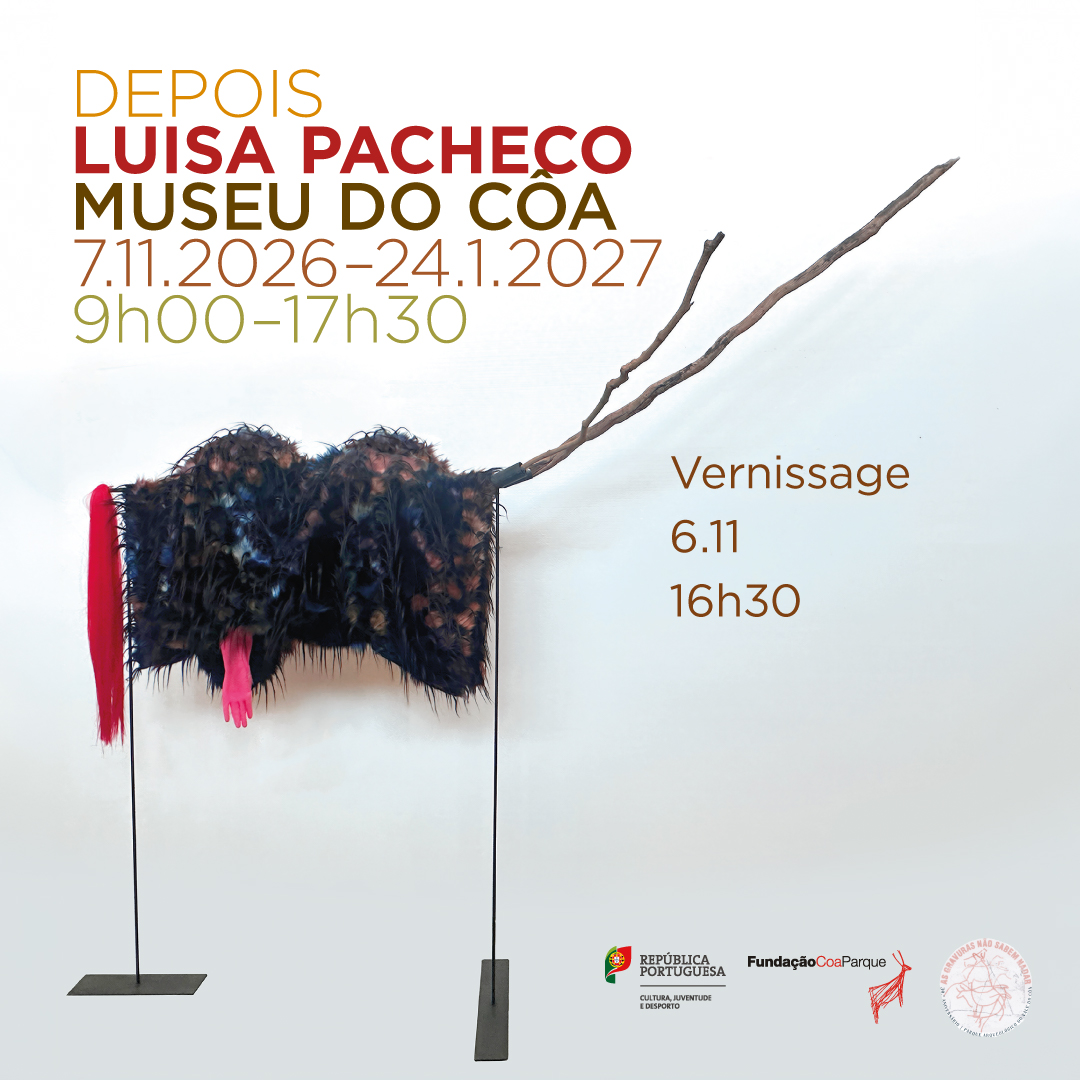
In DEPOIS, I begin with a questioning of the human condition, of what remains and what transforms, and of the ways in which we construct, represent and interpret reality.
What distinguishes before from after? What remains when everything we know changes? I am interested in exploring this territory of uncertainty, where different temporalities coexist and memory ceases to be merely a trace of the past, becoming instead an active material in the construction of new possibilities.
The exhibition unfolds as a map of survival, pain and love, composed of recorded moments, fragments and future memories. I am interested in the proportional relationship between pain and love, as inseparable forces that continually transform one another. Survival emerges as a continuation of this transformation, as the capacity to carry what remains into what is still unknown.
Through painting, sculpture, installation, objects and reflective surfaces, I construct an unstable cartography in which images fragment, multiply and shift. Reflections extend beyond the physical boundaries of the works, superimposing different times, presences and absences. The viewer’s movement continuously redraws this map, in a potentially infinite process in which each image holds the possibility of another.
I also question the relationship between human beings, nature and contemporary systems of representation. The condition of women, mechanisms of power and control, the ecological crisis and the technological transformation of images run through this reflection on the proximity between imagined dystopia and the reality we inhabit.
At the Côa Museum, ancestral records of human existence encounter these images of a present in transformation. Between the traces of the past and the construction of future memories, I am interested in what persists in the human need to represent, preserve and reinvent experience.
DEPOIS does not seek to represent a moment following an event, but rather what takes place during transformation. A map in perpetual construction, where pain, love, survival, presence and absence coexist, and where each fragment becomes simultaneously a memory of what has been and a possibility of what may still come to be.
Perhaps after is not what follows before, but the eternal movement through which both continue to exist.